Monday, July 19, 2010

#30: Coolidge, Calvin

Calvin Coolidge
July 4, 1872 (Plymouth Notch, Vermont) - Jan. 5, 1933 (Northampton, Mass.)

I get by with a little help from my friends
(or, more specifically, my mom and my nieces).

  • This bears direct transcription: "COOLIDGE, CALVIN (1872-1933), was a shy, silent New England Republican who led the United States during the boisterous Jazz Age of the 1920's. He was the sixth Vice-President to become President upon the death of a chief executive. Coolidge was vacationing on his father's farm in Vermont when President Warren G. Harding died in 1923. The elder Coolidge, a notary public, administered the oath of office in the dining room. Never before had this ceremony been performed by such a minor official or by a President's father." Coolidge was sworn in a second time eighteen days later by a justice of the Supreme Court, since the Attorney General questioned the validity of the first oath of office. When Coolidge was later asked to recall his first thought upon learning that he would become President, he replied: "I thought I could swing it."
  • Coolidge was known for his even temper. He was "solemn, frugal" in contrast to the boisterous masses... "a public that had largely thrown thrift to the wind," the nation's "flaming youth" as depicted by F. Scott Fitzgerald.
  • As President, Coolidge tried to heal the administration after the corruption scandals of Harding's presidency. He pursued a policy called "constructive economy," supporting American business at home and abroad. He declared: "The business of American is business." In 1924, he easily won reelection, facing no real competition.
  • In the White House, Coolidge's wife was gay and charming, happy to entertain. Coolidge stuck to behind-the-scenes details. "He enjoyed appearing unexpectedly in the kitchen to inspect the iceboxes and to comment on future menus. He once protested mildly because he thought 6 hams were too many for 60 dinner guests. Coolidge also liked to play practical jokes on the staff. He would ring for the elevator, then stride quickly down the stairs, or push all the buttons on his desk just to see all his aides run in at once."
  • While in office, Coolidge's sixteen year old son died from "blood poisoning." He'd developed a blister on his toe while playing tennis, which resulted in an infection that spread! What a way to go! Awful, awful.
  • Coolidge chose not to run again in 1928. He announced this decision by slipping a piece of paper to a reporter which read: "I do not choose to run for President in 1928." When asked to comment upon leaving the capital, he said: "Good-bye, I have had a very enjoyable time in Washington."
  • The stock market crash of 1929 distressed Coolidge, who felt he may have done more to avert it while in office. He was increasingly unhappy in the early 30s. In 1933, Mrs. Coolidge found President Coolidge lying on the floor of his bedroom. He had died of a heart attack.

#29: Harding, Warren G.

Warren G. Harding
Nov. 2, 1865 (Corsica, Ohio) - Aug. 2, 1923 (San Francisco, California)


"I'm tweaking into a whole new era, g-funk, step to this I dare ya."

  • From the sublime to the subprime... if World Book luvved Woodrow Wilson, it certainly does not luvv Warren Gamaliel Harding (and yes, that is seriously his middle name). According to World Book, "Historians almost unanimously rank Harding as one of the weakest Presidents." He was elected primarily as a repudiation of Wilson's ambitious foreign policy and aggressive social agenda. Harding campaigned on the slogan "Back to Normalcy," in the post-World War I era. It's unclear what "normal" was, but the American people were happy to elect a president who didn't have much of an agenda at all.

  • Warren G. Harding has perhaps only one thing in common with my father: they are both the eldest of eight children.

  • Before going into politics, Harding made his career as a newspaper man. When he was in his early twenties, he and his friends bought a bankrupt weekly paper in Marion, Ohio, for $300. He turned it into a prosperous daily, using his skills as an editor and orator.

  • Over the course of Harding's political career--from state senator, to lieutenant governor, to U.S. Senate--he became known for being "genial and popular," but not for getting things done. As a Senator he did not introduce a single bill. He voted in favor of woman's suffrage, but admitted to a group of suffragists that he was "utterly indifferent" to the issue.

  • Harding was chosen as the Republican party's nominee for the presidency at the 1920 party convention in Chicago. The convention was deadlocked after four ballots. Harding was selected as the compromise candidate in a smokey backroom at the Blackstone Hotel, in the wee hours of the morning. Talk about political kingmaking! Calvin Coolidge, the cool-as-a-cucumber governor of Massachusetts was selected as VP.

  • Harding's administration was marked by nepotism. He brought so many buddies with him from his homestate that they became known as "the Ohio gang." This, predictably, erupted into political scandal with the Teapot Dome incident: Harding's Secretary of the Interior accepted a bribe for leasing government-owned oil reserves to private companies. He was sent to prison. World Book speculates that this scandal contributed to Harding's early demise...

  • Farm regions in the US suffered a serious depression in 1922. The following year, Harding decided to go on a speaking tour to "revive confidence in his administration." While he was traveling, Harding received news from Washington about a Senate investigation into the oil leases. This apparently disheartened him and he later fell ill when passing through Seattle. It's possible that he suffered some form of food poisoning. By the time the presidential trip made it to San Francisco, Harding was diagnosed with pneumonia. He died there on August 2, 1923. He was buried in Marion, Ohio. No autopsy was performed and the precise cause of death was never ascertained.

Too Big to Fail

I am facing down the last two weeks of my clerkship and still have over a dozen presidents to do... lordy, how did this thing get away from me?


Here's an interesting article about the two most recent presidents on the bloggity-blog to tide you over until I rally for the original Warren G.

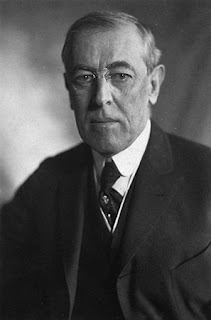
Stop look so judgey, Woody... I'm trying to finish this project, I swear!

Monday, July 12, 2010

#28: Wilson, Woodrow

Woodrow Wilson
December 29, 1856 (Staunton, Virginia) - February 3, 1924 (Washington, D.C.)

Woodrow "Smudgey face" Wilson


World Book hearts Woodrow Wilson in a big way: "Before reaching the height of popularity as a world statesman, he had achieved success in two other careers. First, as a scholar, teacher, and university president, he greatly influenced the course of education. Then, as a political leader, he brought successful legislative reforms to state and national government. Wilson would have won a place in history even if he had been active in only one of his three careers. . . . Historians consider Wilson one of the three or four most successful Presidents."

Wilson had three daughters with his first wife. Wilson's first wife died while he was serving his first term as President. He was heartbroken. A year later he met his second wife, a widow of a Washington jeweler, and remarried.

We can thank Wilson for:
  • The residential college system at Yale (what what!)--he tried to put a "preceptorial system" in place at Princeton, but those snobs were too attached to their eating club system to accept it. Yale and Harvard adopted his vision of the "quad plan" with separate colleges, each arranged in a quadrangle around a central court, with its own dorms, eating hall, master and tutors;
  • Keeping us out of World War I for almost three years, for what that's worth (he was wedded to peace until the Germans started attacking American ships without warning in March 1917)--his adamant stance on neutrality earned him the nickname, the "human icicle";
  • Creating an independent Department of Labor and ushering in new labor laws like the Adamson Act (establishing the eight-hour work day) and the Child Labor Act (limiting the number of hours children can work);
  • The League of Nations (for what that's worth).
President Wilson was the first American president to cross the Atlantic Ocean while in office. He spent months abroad in 1918-19, enjoying a enthusiastic reception after WWI from European people who considered him a great statesman for helping negotiate the Treaty of Versailles. He had a hard time winning support for the peace agreement at home and an even harder time winning support for the League of Nations. In September 1919, Wilson began a speaking tour of the US to drum up support for the League among the American people (Wilson was an awesome orator). He suffered a paralytic stroke while traveling from Pueblo, Colorado to Wichita, Kansas, on October 2, 1919, and ultimately served the rest of his term as an invalid. He did not call a cabinet meeting until April 13, 1920. In the intervening months, the cabinet met "unofficially and carried on much of the routine work of government during Wilson's long illness."

Wilson's work in advocating for the League of Nations was quickly dismantled by his Republican successor: Warren G. Harding.

Wilson died in his sleep on February 3, 1924. He was buried in the Washington Cathedral. He is the only President interred in Washington, D.C.

Saturday, July 3, 2010

#27: Taft, William

[GUEST BLOG ENTRY!!!! from my dear friend Eric... As an aside, I am in San Francisco with a band of buddies, two of whom are from Ohio. These two Ohioans married each other last year in a lovely ceremony at the Taft Museum of Art, which was erected at the site where Taft accepted the Republican nomination for the presidency in Cincinnati. Says one Ohioan, "The Tafts are winners."]

William Taft
September 15, 1857 – March 8, 1930


Glad to lend a hand to my favorite blog about drawing and researching the Presidents! I used my parents' 1985 World Book set, which remains within easy reach in their front hallway coat closet an astounding 25 years later! For my drawing, I used pen and paper; I got a little carried away with the hair and moustache.
  • World Book mentions Taft's infamous heft a quite a few times. My favorite reference: "A newspaperman wrote that he looked 'like an American bison--a gentler, kind one.'" (neither newspaper nor newspaperman specified) Let's just say you could fit at least two Obamas in this guy.
  • Taft didn't really want to be President. His mother thought he would be happiest as a judge, but his wife thought he was better fit for the Presidency. "In the end, Taft's mother proved to be right." In 1913, Taft told incoming Prez Woodrow Wilson, "This is the lonesomest place in the world." So emo!
  • Here are some things that happened during his Presidency (1909-1913): New Mexico and Arizona became the 47th and 48th states. The 16th Amendment became law, giving Congress the legal power to levy income taxes. The Post Office began parcel-post service. Imagine where Zappos would be today if this hadn't happened!
  • Like his predecessor, Taft was all about the trust busting. "Nearly twice as many 'trust busting' prosecutions took place during Taft's four years in office as had occurred during Roosevelt's administration of almost 8 years."
  • Taft had a ridiculously impressive political trajectory: 1890: Solicitor General, 1892: Federal Judge (6th Circuit Court of Appeals), 1901: Governor of the Philippines (!?), 1904: Secretary of War, 1908: Prez, 1921: Chief Justice of the Supreme Court. World Book points out that becoming Chief Justice was his proudest accomplishment. I would like to point out that becoming Guv of the Philippines was his weirdest accomplishment, or at least the last possible thing you would guess he did for a living if you saw a picture of the guy. (Unless your only reference is my drawing, in which he looks ambiguously ethnic, and maybe could pass for Filipino) WB: "Taft's career in the Philippines was an example of the best in colonial government." Hmm...
  • His son, Robert Alphonso Taft, "...became a famous U.S. Senator from Ohio.' (never heard of him)
[ed. -- Thank you Eric! You're a champ.]

Thursday, July 1, 2010

Interlude

Earlier this week, a team of construction workers unearthed the crypt of Michigan’s first governor, Stevens T. Mason, in Capitol Park in Detroit. The plan is to move the remains to a more prominent location. According to mlive.com, this is the third time Governor Mason’s remains have been moved: “Mason died in 1843 in New York, but his body was moved to Detroit's Capitol Park in 1905. His remains were moved to another location in the park in 1955.” However, no records of the 1955 move exist.

Stevens T. Mason, the “Boy Governor,” was elected territorial governor of the Michigan Territory at age 22 and then elected governor of the State of Michigan at age 24, in 1835. According to Wikipedia, “Mason is the youngest state governor in American history.” I tell you this for several reasons. First, it is an interesting historic tidbit and, while obviously a modest detour from the task at hand, I’m all about interesting historic tidbits. Second, Michigan being my home, I am proud that we had such a youngling for a leader in the early heady days of statehood. Admittedly, his youth makes me feel vaguely inadequate in much the same way that Beyonce’s age (seven and a half months my junior) makes me feel like an utter failure. Nevertheless, personal insecurities aside, this Mason fellow is fairly impressive. And finally, there is something grimly fascinating about old bones (or maybe ashes?) being uncovered a few blocks from my workplace.

Ok. Interlude over. A dear friend is working on a guest entry (!) for President Taft, so that’ll be up soon.

Tuesday, June 22, 2010

#26: Roosevelt, Theodore

Theodore Roosevelt
Oct. 27, 1858 - Jan. 6, 1919


Hello friend. I haven't forgotten about you or this little project. Work has gotten a bit more stressful (and my level of efficiency has sadly not improved). Nevertheless, here we are with President #26--Teddy Roosevelt, who was the youngest man ever to become president. He was 42 when McKinley was assassinated. He served two terms, from 1901 to 1909. He was a big bear of a man who "regarded public life as a great stage" according to World Book.

Things Roosevelt said:
  • He practiced what he called the "strenuous life"--boxing, horseback riding, swimming, hunting, hiking...
  • He said as president, "I did not usurp power, but I did greatly broaden the use of executive power."
  • Of his foreign policy: "Speak softly and carry a big stick."
  • Of his time as President: "I do not believe that anyone else has ever enjoyed the White House as much as I have."
  • During the run-up to the Spanish American War, when Roosevelt was Assistant Secretary of the Navy, he said President McKinley had "no more backbone than a chocolate eclair."
Things Roosevelt did:
  • Busted trusts (big business monopolies)!
  • Regulated railroads!
  • Passed laws to protect people from harmful food and drugs after reading Upton Sinclair's novel The Jungle!
  • Supported a revolutionary government that took control of Panama so he could get his #@$!$ canal! He later visited Panama and was the first President to travel to a foreign country while in office.
  • Added over 125 million acres to the national forests in the interest of conservation!
  • Ran for a third term in 1912, after the Republicans lost confidence in the then president William taft! He ran on the Bull Moose ticket, so named because after Teddy was asked how he felt, he answered, "I feel as strong as a bull moose." He lost that election to Woodrow Wilson.
Roosevelt died in 1919 from complications of a jungle fever he'd contracted while exploring in Brazil. Around the same time, he admitted that he had been blind in his left eye since 1905. He had lost the sight while boxing with a military aide in the White House!

Monday, June 7, 2010

#25: McKinley, William

William McKinley
Jan. 29, 1843 (Niles, Ohio) -- Sept. 14, 1901 (Buffalo, New York)

Watercolor!
(His face is shiny because I didn't wait for it to dry before taking the picture. I'm sleepy.)

McKinley succeeded Grover Cleveland in 1897. He was the third President to be assassinated and the fifth to die in office! That's a lot given that he was only #25.

"Others sometimes regarded [McKinley] as cold an pompous, perhaps because of his rigid bearing, piercing eyes, and his tight, thin lips. He went to church regularly and lavished great care and affection upon his invalid wife." She suffered from shock and grief after both her daughters died at a young age. She later developed epilepsy. "McKinley was devoted to his wife and constantly cared for all her needs. When he was governor of Ohio, he would turn before entering the state house in Columbus, then remove his hat and bow to his wife in their hotel room window across the street. He waved to her from a window at 3 o'clock every afternoon." Later during his campaign for President, McKinley refused to leave his wife for long campaign tours. Therefore, McKinley's friend and political patron, Marcus A. Hanna, a Cleveland millionaire, "arranged to have thousands of visitors travel to Canton[, Ohio]" where McKinley would give short, rehearsed speeches from his front porch. He was elected and became president in 1897.

McKinley campaigned on raising tariffs (good ol' American protectionism) and enacting a new gold standard for currency. I have to be honest that the last few presidential entries in this historical romp through the 1981 World Book have involved lengthy passages about currency scandals, the silver standard, the gold standard, crazy inflation, and so forth. I don't understand any of it so I haven't been including it... not necessarily the best approach, I admit.

At the beginning of McKinley's first term, a Cuban revolt was raging against Spanish rule. In 1898, a U.S. ship exploded in Havana harbor (nobody ever figured out why). Assistant Secretary of the Navy, Theodore Roosevelt, urged McKinley to declare war. McKinley waffled. Roosevelt called him a "white-livered cur" who had "prepared two messages, one for war and one for peace, and doesn't know which one to send in." McKinley finally declared war on April 11, 1898. The Spanish-American War lasted only 113 days, but in the end the U.S. acquired Guam, the Philippines, and Puerto Rico. (In McKinley's second term, the Supreme Court affirmed that the residents of these new dependencies did not have the rights of citizens and that Congress could impose tariffs on their trade). Roosevelt, who had returned a hero from the Spanish-American war, was selected as McKinley's running mate for his second term.

McKinley was assasinated six months into his second term. He was appearing at a public reception during the Pan-American Exposition in Buffalo. Hundreds of people waited to shake his hand. Leon F. Czolgosz, an anarchist, approached him, grasped his hand, then shot him twice with a revolver he'd concealed with a handkerchief in his left hand. According to World Book, "McKinley slumped forward, gasping, 'Am I shot?' The crowd pounced on the assassin and began beating him. McKinley pointed to Czolgosz, imploring, 'Let no one hurt him.' He whispered to his secretary: 'My wife--be careful, Cortelyou, how you tell her--oh, be careful.'" Czolgosz was later electrocuted.

Sunday, May 30, 2010

Net Worth

Fascinating stuff, courtesy of bruns (thank you thank you):


The Net Worth of The American Presidents: Washington to Obama

Saturday, May 29, 2010

#23: Harrison, Benjamin

Benjamin Harrison
August 20, 1833 (North Bend, Ohio) - March 13, 1901 (Indianapolis)

I drew this absent-mindedly over a failed drawing of Grover Cleveland. Harrison looks a bit like a hartebeest, another featured creature of the "H" volume.


Benjamin Harrison is the only president to be the grandson of another president: William Henry Harrison (#9), hero of the Battle of Tippecanoe. Harrison won the 1888 campaign against Grover Cleveland with the help of a Republican campaign song: "Grandfather's Hat Fits Ben." Like his grandfather, he only served one term, failing to be reelected in 1893.

As president, Ben Harrison presided over some serious federal legislation, including adoption of the Sherman Antitrust Act of 1890. He also launched a program to build a two-ocean navy and expand the merchant marine (by the time of Harrison's presidency the West had essentially been won--North Dakota, South Dakota, Montana, Washington, Idaho and Wyoming all joined the Union during his term). In the first part of his term, both houses of Congress were Republican (like Harrison) allowing him to enact an ambitious legislative program and also spend a lot of money. Democrats were elected in great numbers during the mid-term elections in response to this spending. The new Democratic Speaker of the House, Thomas Reed, allegedly exclaimed: "This is a billion-dollar country!"

In the last days of Harrison's presidency, Queen Liliuokalani lost her throne in Hawaii in a revolution led by American planters. Harrison tried to rush a treaty of annexation to the Senate before leaving office--making Hawaii a U.S. territory--but when Cleveland returned to the presidency he withdrew it before the Senate could act. Cleveland called "the whole affair dishonorable to the United States."

Harrison's wife died two weeks before the national elections in the fall of 1892. Harrison was beat by Cleveland and in 1893 he returned to Indianapolis, where he had practiced law before entering politics. He remarried--his widowed niece (in law, I presume/hope). He died at home in 1901.

Thursday, May 20, 2010

#22 & #24: Cleveland, Grover

Grover Cleveland
March 18, 1837 (Caldwell, NJ) – June 24, 1908 (Princeton, NJ)
Note: Cleveland is the first president to be featured on this blog who lived into the 20th Century! Hoorah! Also, World Book lists two of his five children has still living as of the date of publication (1981)! Which is to say, my life and the life of Grover Cleveland's kids overlapped for a bit. I feel very close to him all of a sudden.


With Mr. Cleveland, we knock out two presidents in our slow trudge towards forty: numbers 22 and 24. President Cleveland has the distinct advantage of being the only president who served two terms non-consecutively (Harrison interrupted but we'll get to that soon enough). Cleveland was the first Democrat elected after the Civil War--things were starting to settle down, but corruption in government was still a big issue.

Word Book describes Cleveland as a "big, good-humored man, called 'Uncle Jumbo' by his relatives."

For a short time, Cleveland served as sheriff in Buffalo. "During his term [as sheriff], the county had to hang two convicted murderers. Most sheriffs had delegated this distasteful task to deputies, but Cleveland sprang the traps himself. He explained that he would not ask anyone else to do what he was unwilling to do."

After serving as sheriff, he was elected mayor of Buffalo, and after that governor of New York. All along he was considered a reformer, vetoing padded bills... he earned a reputation for wisdom, but also the hatred of Tammany Hall Democrats.

Cleveland's presidency, both the first and second term, were marked by labor unrest. During his second term, he tried to break up the Pullman Strike of 1894 first by court injunction, then by sending in federal troops to break up unions in an insane presidential power grab.

Cleveland is the only President to get married in the White House. He married Frances Folsom when she was 21 and he was 49--it was about a year into his first term. She had been his ward since her father died in 1875 (when she was 11). Her father had shared a law practice with Cleveland. This has a whiff of "ew" reminiscent of Celine Dion and René Angélil's bizarre marriage.

Cleveland had cancer of the mouth early in his second administration. He kept it a secret, to the point where he even arranged to have secret surgery on a friend's yacht in New York Harbor to remove part of left upper jaw. He wore a rubber jaw that allegedly made the removal hardly noticeable.

Cleveland died in 1908. According to World Book, his last words were: "I have tried so hard to do right."

Saturday, May 15, 2010

#21: Arthur, Chester

and.... I’m back! Today with a fellow named Chester Arthur, our twenty-first president, and the successor of James Garfield who was assassinated in office in 1881.

Chester A. Arthur
Oct. 5, 1829 (Fairfield, Vermont) - Nov. 18, 1886 (New York, New York)


World Book says: "Arthur enjoyed fashionable surroundings and fine clothes. He also liked to entertain friends. Tall, ruddy, and handsome, Arthur was sometimes called the "Gentleman Boss."

Arthur rose through the ranks of the Republican Party machine, as a protege of New York Senator Rosco Conkling. New York politics were rife with graft and waste, and Arthur was a great beneficiary of the system. However, as President, he faced tremendous popular demand for political reform and for a better system of filling public offices. He thus signed into law the Pendleton Civil Service Act, to the shock and disappointment of his party machine cronies. His administration became known for its honesty and efficiency.

Before becoming President, Arthur held a variety of political posts and before that he was a lawyer at a New York City law firm. He was known as a civil rights crusader, and won a case in 1855 that establish the rights of blacks to ride on any streetcar in the city.

Arthur's wife died a year before he was elected Vice President. As President, he asked his youngest sister to serve as his hostess. According to World Book, "Arthur though the White House looked like 'a badly kept barracks,' and ordered it renovated." As a result, he lived in the Washington home of Senator John P. Jones of Nevada for the first several months of his presidency.

While he was president, Congress sought to pass a bill banning Chinese immigration for twenty years. Arthur vetoed it, because he said it violated a treaty with China. Congress amended the bill to limit the prohibition for ten year and it became law.

A year into his presidency, Arthur learned that he had a fatal kidney disease called glomerulonephritis, or Bright's Disease. He was often in great pain, but kept the illness a secret (just like Jed Bartlet!). Because of his illness, he quietly avoided being nominated to a second term.


Thank you for reading and now, a public service announcement:

If you want to have a son that grows up to look like this (below),
name him Chester.
Test this wisdom at your own peril, my friends.

Sunday, April 25, 2010

#20: Garfield, James Abram

James Abram Garfield
20th President of the United States - HALFWAY, woop woop!
Nov. 19, 1831 (Orange Township, Ohio) Sept. 19, 1881 (Elberon, New Jersey)


  • The World Book entry on James Garfield begins: “GARFIELD, JAMES ABRAM (1831-1881), was the last President to be born in a log cabin. Nobody knows what kind of President he would have been, because he was assassinated only a few months after taking office.” Such drama and such brevity! I aspire to write as well. Also, what is it with log cabins that holds the American imagination so captive? I have my own thoughts, but I'll let you ponder upon it.

  • According to World Book, “Garfield was a big, athletic, handsome man with blond hair and beard.” To wit (minus the beard):


  • He was super smart too. “He occasionally entertained his friends by writing Greek with one hand and at the same time writing Latin with the other.” Boy, would I have liked to party with him.

  • Garfield was nominated for the presidency in part because the fractured post-war Republican party (two factions in particular: the Stalwarts and the Half-Breeds) couldn’t agree on a nominee. Garfield was the “dark horse.” Also, he had quite the leadership pedigree. He'd been a college professor, college president, lawyer, major general in the U.S. Army, and Congressman.

  • Four months into his first term, Garfield was shot by a disappointed job seeker, Charles J. Guiteau. The shooting occurred while Garfield was waiting for a train on his way to attend the 25th reunion of his class at Williams College (which I visited many moons ago on a college campus tour of New England with my mom, and which has a James A. Garfield Collection, should you be interested in researching the man further). As President, Garfield had begun filling hundreds of government jobs with his supporters--the Spoils System, which Rutherford B. Hayes supposedly put an end to, rearing its ugly head. Guiteau had wanted Garfield to appoint him as U.S. consul to Paris, which Garfield didn't do. So he shot him. After the shooting, Garfield “lay near death for 80 days.” A single bullet had lodged in his back and surgeons could not find it. “Alexander Graham Bell tried unsuccessfully to locate the bullet with an electrical device.” World Book says that Garfield remained "calm and cheerful." Garfield ultimately died from infection of the wound. Ew. And sad.

Thursday, April 22, 2010

Feedback from Ohio's Native Daughter

A dear friend who happens to hail from Ohio wrote me this a propos Rutherford B. Hayes:

Hayes is the name of the high school in Delaware, Ohio, where you note that Hayes was born. Delaware is a charming small town and until the suburbs started to sprawl like crazy after I left for college, it was really the only town for the next 1.5 hours after my parents' house. They enjoy going there for antiquing, eating a leisurely lunch, going to "mass with the nice priest" (as opposed to their parish), etc.

Interestingly, Hayes' mascot is the Pacers or something similarly horsey, named after a nearby race track? Not very presidential. But in Marion, Ohio, home of Warren G. Harding, their high school mascot is the Presidents. I remember their swim caps having an especially ugly presidential seal of some sort. There's also a Harding high school in Warren, Ohio but their mascot is the Raiders.

We heart our presidents in Ohio. :)


I will venture this hypothesis: in this great nation, there is a school named after every single president, even the miserable ones (see, e.g., here and here). That's presidential love!

Wednesday, April 21, 2010

Presidential Miscellania

I saw this play over the weekend and recommend it if you are in New York. Good fun and Martin Van Buren is a riot.

Also, exciting news in currency, if there is such a thing. (via)

#19: Hayes, Rutherford Birchard

Rutherford B. Hayes
19th President of the United States (served 1877-1881)
Oct. 4, 1822 (Delaware, Ohio) - Jan. 17, 1893 (Fremont, Ohio)

From a good beard to better!

  • Hayes was the first president to be elected by a margin of only one vote. The election had to be decided by a special congressional commission. During his presidency, he ended Reconstruction (pulled federal troops out of the South) and ended the Spoils System (based his appointments on merit). Otherwise, his was a remarkably unremarkable reign.
  • “Hayes was a champion speller in elementary school. He later boasted that ‘not one in a thousand could spell me down!’”
  • During the Civil War, Hayes was quickly promoted. He “distinguished himself in several battles . . . . He was wounded four times and had four horses shot from under him.”
  • Hayes had a hand in expanding the Library of Congress and he helped found the college that would later become Ohio State University.
  • Hayes’s wife was the first First Lady to have gone to college. She and her husband introduced the custom of Easter egg rolling by children on the White House lawn.
SIDENOTE: I recently started watching the West Wing. I’m almost through the first season and it amazes me how every episode feels topical and relevant almost ten years after the show first aired. For example, one episode addressed the politics of the census when I filled out my census questionnaire. Another episode addressed the national parks and Yellowstone when I was writing about Ulysses Grant. The latest episode addressed the Easter egg roll while I was writing this entry! Not to mention all the issues (gays in the military, nuclear disarmament, state dinners for visiting dignitaries gone awry) that speak directly to issues faced by the current administration. Insane! Or perhaps merely a sad commentary on how little politics change! But either way, I highly recommend it!!!

BONUS BITS from the “H” volume! (We've already visited the "H" volume--hello there again, Mr. Harrison--but nevertheless I stumbled upon these gems and had to share)
  • There is an entry devoted to “Hats.” In what context would this be useful? No idea, but it’s delightful to peruse. It includes a feature on “How a Felt Hat Is Made,” as well as an explanation of “Why People Wear Hats.” According to World Book, “people wear hats for three main reasons: (1) protection, (2) communication, and (3) decoration.”
  • I learned that manufacturers can use the air bladder of a squirrel hake to make glue. Wha????
  • And I found separate entries for "Hand," "Head" and "Human Body." According to World Book, "HAND is the end of a forelimb, or arm. Hands are specially constructed for taking hold of objects. True hands have opposable thumbs . . . " True hands! Priceless.

Saturday, April 10, 2010

#18: Grant, Ulysses

Ulysses S. Grant
April 27, 1822, Pt. Pleasant, Ohio - July 23, 1885, McGregor, New York

What a beard!

  • What's in a name? According to World Book, Grant was born Hiram Ulysses Grant. Hiram! That is totally going on my short list of names for my as-yet unborn sons. (Kidding, kidding... I don't have such a list, but if I did, Hiram would be way up top.) When he was seventeen, Grant's father found out that a neighbor's son had been dismissed from the U.S. Military Academy. He wrote his congressman to appoint Ulysses as a replacement (little 'Lyss had been going to school at an academy in Ripley, Ohio in the meantime). The congressman agreed, but when he made out the appointment he wrote it for "Ulysses S. Grant," mistakenly thinking the boy's middle name was his mother's maiden name, Simpson. 'Lyss never bothered to change it; "He thought his classmates might tease him about his real initials, 'H.U.G.'" Later, as a military commander, Grant earned the nickname "Unconditional Surrender Grant" after, on his own initiative, he took Fort Donelson in 1862 and refused to give the fort commander any concessions upon surrender. He was later called a "butcher" because he lost so many men in battle.
  • Grant was the first West Point graduate to serve as president. After graduating in 1843, he fought in the Mexican War (including participating in the capture of Mexico City). He was later stationed in Detroit (hey-yo) and also Sackets Harbor, New York, before being sent to the West to serve at Fort Vancouver in the Oregon Territory and Fort Humboldt in California. Grant eventually resigned, preferring to return to be closer to his wife and four children. After a series of business failures, he returned to the Army in 1861 to fight for the Union (he freed his only slave in 1859). Grant quickly moved up the ranks from drill captain to colonel to brigadier general to lieutenant commander. He was ultimately named supreme commander of all Union armies by Lincoln in 1864. He led the North to victory and emerged from the Civil War a national hero. In the North, people admired him for his fierce tenacity and in the South people respected him for having given General Robert E. Lee generous terms of surrender.
  • World Book refers to Grant as "trustworthy" and "shy and retiring." He was a talented horseman. His career outside the army as a young man was marked by business failures. He tried his hand as a farmer, a real estate agent, a landlord, and a store clerk. He was terrible at all of them. His unluckiness followed him after his presidency--in retirement he invested all of his savings (about $100,000) in a banking firm, for which his son, Ulysses, Jr., was a partner. The bank turned out to be run by a dishonest man and the company ultimately failed, leaving Grant almost penniless. In his old age, Grant turned to writing his memoirs for income. Mark Twain became his publisher. The memoirs earned his family $500,000!
  • Grant's presidency (1869 - 1877) was marked by widespread political corruption--he vowed not to be ruled by professional politicians in his inaugural address and instead appointed personal friends and army officers to government offices. The spoils system quickly thrived and over the course of his two terms in office, government fraud ballooned. During his presidency, Grant presided over two financial panics: Black Friday (spurred by a gold speculation scandal) and the Panic of 1873 (spurred by the failure of several Eastern banks). All the while, Grant continued to accept personal gifts and his cabinet members accepted bribes left and right.
  • Despite all the scandals, Grant succeeded in reducing the national debt. While he was president, the First Transcontinental Railroad System was completed, which I learned about from a Lucky Luke comic book, "Des Rails sur la Prairie." (Come to think of it, almost everything I know about the American West I learned from either Lucky Luke or the Magnificent Seven.) Grant also presided over the creation of Yellowstone National Park in 1872. Hooray for national parks! Hip hip...
Bonus drawing!
(that is a tree trunk Grant is leaning against, for your information)

Sunday, March 28, 2010

#17: Johnson, Andrew

Andrew Johnson
(Dec. 29, 1808, Raleigh, NC - July 31, 1875, Carter Station, Tennessee)


  • Mr. Johnson was the first president to be impeached; he was the first and only president who had never gone to school (he was a tailor by training); he was the first president to grant a reporter a formal interview; and he was the first and only former president to serve as a Senator (he ran and won in 1874, six years after his term as president ended).
  • Even though Johnson was a completely self-taught man (well almost completely--his wife taught him arithmetic and how to write), he diligently worked his way up the political ladder: from town alderman in Greenville, Tennessee, to the Tennessee House of Representatives, to Governor of Tennessee, to U.S. Senator, to Military Governor of Tennessee during the Civil War and finally to Vice President in Lincoln's second term (though notably Johnson owned 8 slaves, often advocated a "middle ground" on the slavery issue--sort of like being "kind of pregnant" or "very unique"--, and he was a Democrat on the Republican ticket). The World Book account of Johnson's inauguration bears quoting directly:
He had recently recovered from an attack of typhoid fever, and was still weak. On his way to the ceremony in the Senate, Johnson stopped to rest. He drank some whisky, thinking it would strengthen him. In the heat of the Senate chamber, and because of his weakened condition, Johnson became tipsy. His jumbled speech embarrassed even his friends. For many years, Johnson's opponents accused him of drunkenness, but the accusation was unjustified. Lincoln remarked: 'I have known Andy for many years; he made a bad slip the other day, but you need not be scared. Andy ain't a drunkard.'
  • The morning after Lincoln's assassination, Johnson took the oath of office in his hotel room. In the four-year term that followed, he fought Radical Republicans intent on punishing the South. This resistance led to his tremendous unpopularity and eventual impeachment (though the Senate acquitted him in the impeachment trial). One of his lawyers at his impeachment trial wrote: "He is a man of few ideas, but they are right and true, and he could suffer death sooner than yield up or violate one of them." How's that for a backhanded compliment! During the trial, Radical Republican voters threatened Senators who did not vote in favor of impeachment. One voter, for example, warned, "Any Republican Senator who votes against impeachment need never expect to get home alive." My, my. Politics can get quite ugly.
  • During Johnson's presidency, the U.S. acquired Alaska from Russia for $7.2 million in 1867. The deal was negotiated by Secretary of State William Seward--many American called Alaska "Seward's folly" for years thereafter. Recently, Discovery confirmed that it had finalized a deal with Sarah Palin to do an eight-part travelogue show about her home state. Although the series is not yet in production, the cost is estimated at about $1 million per episode. So that would be about $8 million. I can do math.

And that, my friends, is all I have to say about Andrew Johnson.

#16: Lincoln, Abraham... bio

I lost the “L” volume for two weeks! I know, I know… excuses, excuses. But seriously, I couldn’t find it to finish reading the mammoth entry on Lincoln. While presidents like James “Blech” Buchanan get like 3-page entries, Honest Abe gets 17 and a half pages! That’s longer than any president so far.

Things I like about Lincoln:
  • He Was A Bad Lawyer! Not really bad, but as a lawyer Lincoln argued better and more convincingly when he himself was convinced that his client was right. This somehow charms me… it’s a weakness as far as lawyering goes, but it also seems like the result of having a strong moral compass—an admirable quality.
  • He Was A Serial Loser! Lincoln lost plenty of political campaigns before winning the presidency: he lost a campaign for state legislature in 1832 (but won when he ran again in 1834 on the Whig ticket); he lost the Whig nomination for Congress in 1843 and again in 1844 (but won when he presented himself in 1846); he lost the nomination for Congress again in 1854 (but succeeded in getting a colleague who opposed the Kansas-Nebraska Act elected); he won the nomination but lost the election for U.S. Senate to Stephen Douglas in 1858… and finally won the presidency in 1860 without actively campaign for himself! It was considered unseemly at the time for presidential candidates to campaign.
  • The Lincoln-Douglas Debates—Enough Said! The story of Lincoln's debates with Douglas during their race for Senate is inspiring. Compared to modern political debates (over-produced, glossy, lacking in substance, filled with nonsense about flag pins and Joe the Plumber) these debates seem AWESOME. They actually debated real, hard issues (e.g. slavery) in front of real people (i.e. not neutered audiences). According to World Book, both men also toured extensively making speeches on their own while doing the debates. “Before the exhausting campaign ended, Douglas’ deep bass voice had become so husky that it was hard to understand him. Lincoln’s high, penetrating voice still reached the limits of a large audience.” The debates made Lincoln famous across the nation.
  • Insane Presidential Power Grabs! Lincoln took the oath of office and became the 16th president of the United States on March 4, 1861. Civil War broke out on April 12, 1861, with the bombardment of Fort Sumter, in Charleston Harbor, South Carolina. Lincoln responded within two weeks by proclaiming a blockade on Southern ports, expanding the army beyond the limits of the law, suspending habeas corpus in areas where Southern sympathizers were active, and ordering the spending of federal funds without waiting for congressional appropriations. All this to prevent the Union from breaking into pieces. That Abe Lincoln fella was a ballsy man. Ballsy, I tell you!
  • He Was Accessible! As president, Lincoln saw everyone who called upon the White House--including widows and soldiers--and he insisted on writing most of his own letters and all of his speeches. He also made frequent visits to army hospitals (World Book says these visits “tore his gentle heart”).

Lincoln issued the Emancipation Proclamation in late 1862, freeing slaves in Confederate territory. The proclamation didn’t have an immediate effect, since mid-war there was no way for federal officers to enforce it, but it had tremendous long-range effect, paving the way for the Thirteenth Amendment. By 1864, when Lincoln was up for reelection, his popularity had seriously waned—but a series of Union victories turned popular opinion and Lincoln was elected to a second term. He took his second oath of office on March 4, 1865—his face, “gaunt and deeply lined,” bore the effect of four years of war. The war ended on April 9, 1865, when General Robert E. Lee surrendered to General Ulysses S. Grant at Appomattox Court House in Virginia. Lincoln was assassinated a little over a week later on the evening of April 15, 1865 while attending a performance of Our American Cousin at Ford’s Theater in Washington. He was shot by John Wilkes Booth, a prominent stage actor. After Lincoln’s death, “even his enemies praised his kindly spirit and selflessness. Millions of people called him ‘Father Abraham.’”

Friday, March 19, 2010

Falling behind

Losing... steam...

Must... carry... on...


In the meantime, I offer you this, courtesy of this fellow. Presidential humor! What what.